The Opening Read, ES and NQ.
The day’s prep sheet from our own one-minute tape: yesterday’s levels and value area, the Asia range and the London open, overnight inventory, VWAP bands and a plain read of the first 30 minutes.
Session clock
Eastern Time now: shown with JavaScript on
Next-change times are in your time zone: as set on this device. Every market's hours.
· our one-minute tape
Create a free account to use this
It is free. One click with Google or a sign-in link by email. Members get more.
Create a free account with emailAlready have one? Sign in
What it reads, and how it is computed.
What it reads
Our own one-minute candles for the ES and NQ front contracts, recorded through the day and night. Nothing is typed in and nothing comes from a third-party feed. Sessions follow the New York clock: the Globex day starts at 18:00 ET, Asia runs to 03:00, London to 09:30 and the regular session to 16:00.
How it is computed
- Overnight inventory
- The share of overnight minutes (18:00 to 09:30 ET) that closed above the prior session close. 70% or more reads LONG INVENTORY, 30% or less reads SHORT INVENTORY, anything between reads BALANCED.
- First 30 minutes
- R is the high minus the low from 09:30 to 10:00 ET. A close in the top 30% of R with a pullback from the open of 15% of R or less reads DRIVE UP. A close in the top 30% after the low printed first reads TEST THEN UP. The bottom 30% mirrors both as DRIVE DOWN and TEST THEN DOWN. Everything else reads TWO-SIDED.
- Open location
- Where the 09:30 print sits against the prior session range and value area: above range, above value, inside value, below value or below range. A print exactly on an edge counts as the inner side.
- Distances and MSR
- Each level is printed with its distance from the last price when the sheet was built. MSR is the mean session range, the average high minus low of the regular sessions on our tape, so 0.50 MSR is half a typical day’s travel.
- Thirds
- Upper, middle and lower thirds split a range into three equal parts by price.
- VWAP bands
- VWAP is the volume-weighted average of each minute’s typical price, (high plus low plus close) divided by 3. One SD is the volume-weighted standard deviation of those typical prices around VWAP.
Worked example: on Fri, Oct 30 0% of ES overnight minutes closed above the prior session close, so the sheet read SHORT INVENTORY.
Why that information matters
These are the reference points most session plans start from. Seeing where the night traded against yesterday, and how the first half hour behaved, turns a blank chart into a short list of levels to find on your own chart and a plain description of the open.
What it does not tell you
Every word on this sheet is a definition, not a measurement. Nothing on it was tested against what happened next, and none of it says where price goes. A part of the sheet only appears when every minute it needs is on our tape, so nothing on it is filled in by guesswork. This is a description of the session, not advice.
Related, and free.
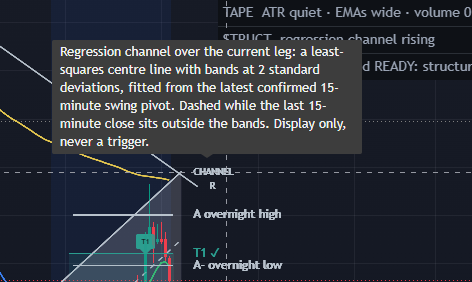
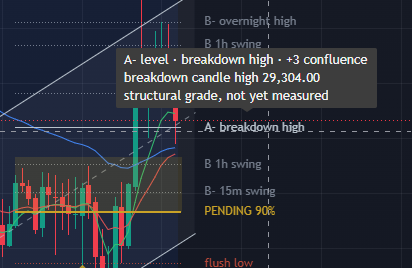
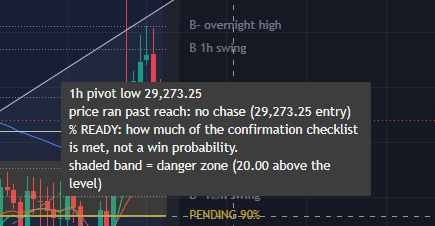
This is what lands on your chart.
No mockups. Every image below is APOLLO ONE running on a live TradingView chart.

The desk does not close at the bell.
Membership includes the Trader’s Edge members server. The prep, the record and the reviews happen in its rooms, every trading day, where you can ask about any of it.
- market-readThe Opening Read for ES and NQ posts here at 03:05, 09:05 and 10:05 ET on trading days.
- track-recordThe forward record, updated daily. Losses are posted the same way as wins.
- trade-reviewsPost a trade you took. It gets read against the plan you had, step by step.
- askA question about a level, a setting or a card on your chart. Ask it here.
- coachingProcess work: the pre-trade checklist, sizing from your risk, and the rules you keep breaking.
- prop-firm-tradersDrawdown rules, consistency rules and evaluation plans, with the free calculators.
Judge the process. It is all in the open.
The stop comes first
Every plan shows the stop under structure before it shows a target. The size comes from your risk, rounded down.
The record runs forward
The track record starts on 2026-10-26 and only moves forward. Losses are kept. Nothing is back-filled.
Every setting explains itself
Hover any setting to read what it measures, how it is computed and what it cannot tell you.
You place every order
Nothing here places, routes or manages an order. It reads the chart. The decision stays yours.
Charting tools and education only. Not investment advice. Trading futures carries substantial risk of loss.
Pick how you pay. The tools are the same.
Access goes to the TradingView username you give at checkout, usually within 15 minutes. A free TradingView plan works. The public tools stay free for everyone.
Founder price, ends October 31
Founder yearly
$299/year
Founder price: $299/year for the first 20 members, through October 31. Same membership as yearly.
- APOLLO ONE on TradingView, invite-only
- ES, NQ, GC and SI, minis or micros
- Every premium tool as it ships
- The members server, every trading day
Yearly
$399/year
Twelve monthly payments come to $599.88. Yearly saves $200.88, about 4 months free.
- APOLLO ONE on TradingView, invite-only
- ES, NQ, GC and SI, minis or micros
- Every premium tool as it ships
- The members server, every trading day
Monthly
$49.99/month
Try it free for 3 days, then $49.99/month. Cancel whenever you want. Access runs to the end of the period you paid for.
- APOLLO ONE on TradingView, invite-only
- ES, NQ, GC and SI, minis or micros
- Every premium tool as it ships
- The members server, every trading day
Secure checkout by Stripe. After you pay, access goes to the TradingView username you give at checkout (a free TradingView plan works), automatically within about 15 minutes, under Indicators → Invite-only scripts. How access works.